
Use Holladay Voter Lookup
The Utah Voter Information Portal is a personal status tool, not an open roll of Holladay names. Enter all six identity and address fields, complete the reCAPTCHA, and choose Submit. Clear removes the entries. Every input is required, so a partial surname, a precinct, or a party cannot be used to browse residents. The address should match the current registration, including the city stored on that record.
| Lookup entry | Input | Required | How Utah treats it |
|---|---|---|---|
| First Name | Text | Yes | No partial-match option is displayed. |
| Last Name | Text | Yes | No partial-match option is displayed. |
| Date of Birth | Masked date | Yes | Use the voter's date; the live format should be followed. |
| Street Address | Text | Yes | Enter the current registered street address. |
| City | Text | Yes | Use the city shown in the registration address. |
| Zip | Masked text | Yes | The application validates the ZIP code. |
| reCAPTCHA | Challenge | Yes | The form will not submit until completed. |
This strict match is deliberate. Public, private, and withheld voters can view their own details, but the form does not double as a public name directory. A failed match can reflect an old address, spelling difference, or other stale input. Check the registration details used most recently, then contact the county elections staff rather than guessing at protected data.
The official lookup screen makes those identity checks visible. Open the Utah voter lookup source before comparing it with the captured interface.
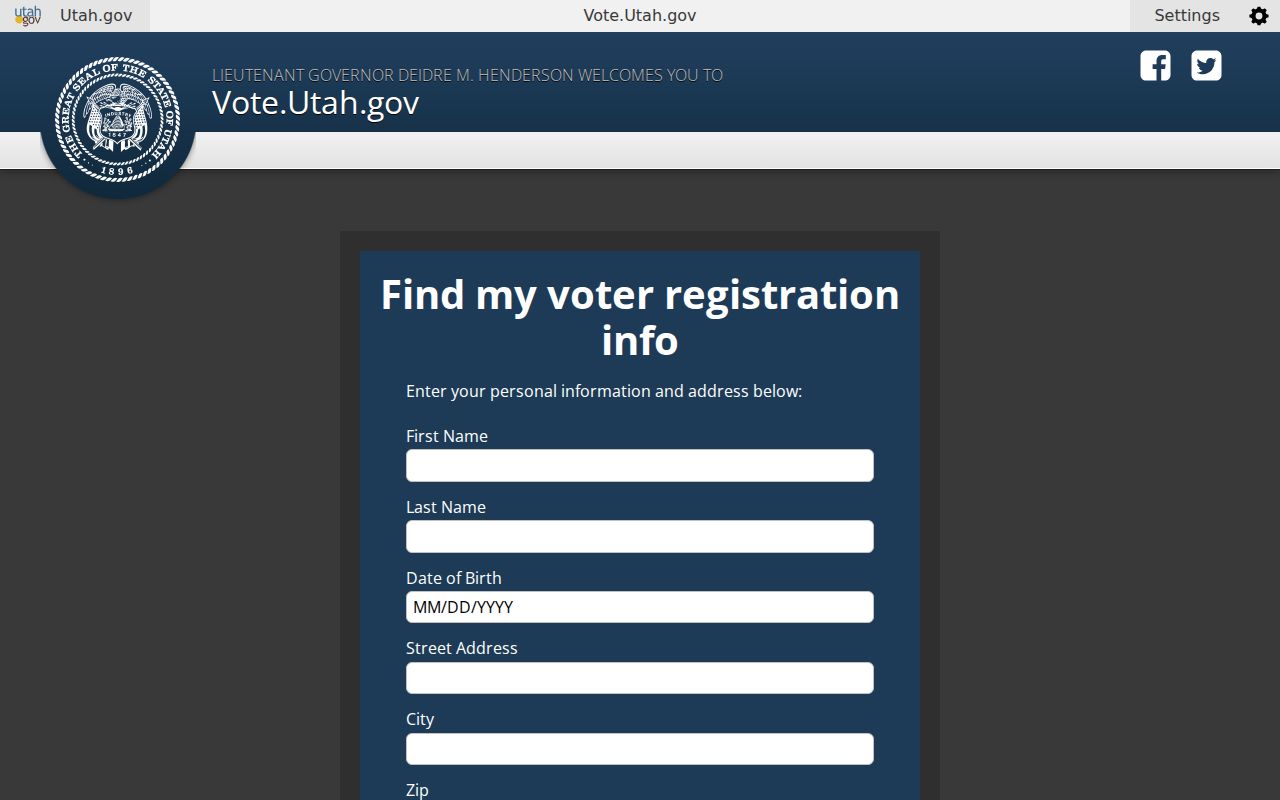
The image confirms that this path begins with a full identity-and-address match rather than a broad Holladay resident search.
Holladay Voter Lookup Results
A successful result ties the registrant to an election geography. The deployed portal identifies a physical residence, including a unit when present, and labels the voting precinct, voting district, State House district, voter ID number, party affiliation, and status information. An inactive message can appear. Current election modules may also provide a polling location, ballot information, or ballot status when those details apply.
Expect a useful record, not a complete life profile. The verified sample inventory is:
- Residence address: the physical address attached to the matched record.
- Precinct and districts: the electoral areas assigned to that residence.
- Voter ID and party: the registration identifier and affiliation or unaffiliated status.
- Registration status: current status messaging, including inactive when applicable.
- Election details: polling and ballot modules shown when relevant to an election.
Live output can change with the election calendar. There is no public result list. Take a mismatch to the elections office instead of changing facts until another person's record appears.
Holladay Voter Records: Public or Protected
Utah's statewide database holds more than the self-lookup displays. Its public portions include a full legal name, voter ID, statutory age range, physical and mailing addresses, county, precinct, district assignments, party, active or inactive status, last update date, and vote history. The district fields can cover Congress, State House, State Senate, state and local school boards, county council, and city council. Different disclosure tiers determine who may receive each part.
| Name and age range | Public; the full birth date is not supplied. |
|---|---|
| Physical and mailing address | Public for ordinary records; withheld for qualified At-Risk registrations. |
| Party and status | Party or unaffiliated status and active/inactive status are public. |
| District assignments | Public electoral geography includes precinct and several district types. |
| Vote history | Shows elections in which the person participated, never ballot choices. |
| Private identifiers | Birth date, license or ID numbers, Social Security data, email, phone, and signature are protected. |
Confidential under Utah law. Utah Code §63G-2-302 protects birth dates, driver-license and state-ID numbers, Social Security data, email, phone, citizenship-proof indicators, privacy forms, and qualifying At-Risk voter information. A public registration never opens those fields.
The governing classifications appear in Utah Code §63G-2-302 and Title 20A, Chapter 2. General access under GRAMA does not override an election-law privacy rule. For that broader records framework, use the Holladay public records access overview.
Holladay Voter Office Contacts
Holladay does not keep a separate city voter roll. The Salt Lake County Clerk's Elections Division processes and maintains local registrations, while the Lieutenant Governor's Office operates the statewide database and tools. County staff can address a mismatch, an address update, a county-level data request, or questions that the online result does not resolve.
Salt Lake County Elections
2001 South State Street, Suite S1-200
Salt Lake City, UT 84190
385-468-7400
vote@saltlakecounty.gov
Online registration or an update requires a valid Utah driver license or state ID. Utah also provides a paper form that can be mailed or emailed to the county clerk, and in-person registration is available. The form supports new registrations, address, legal-name and party changes, ballot-delivery choices, and protected-data notices. Confirm public-counter hours before traveling because the inspected county page did not state them.
Obtain Utah Voter Files
The state voter-data ordering page offers the statewide public file as a one-time purchase. It costs $1,050, is about 150 MB, and arrives as a tab-delimited download. The state says an emailed link is provided within one business day. There are no refunds, subscriptions, or free updates. Ordinary spreadsheet software may not display every row, so the intended reader needs a tool that can handle a file of that size.
- Review the official product description and current privacy terms. Choose the statewide file only if a statewide set is needed.
- Use Submit Your Request to continue to the State of Utah Customer Service portal. Complete the live transaction fields and payment steps shown there.
- Download the tab-delimited file from the emailed link. Keep the delivery, fee, snapshot date, and source details with the data.
A Holladay-only, county, precinct, or district list is not carved out by the statewide product. Request a narrower list from the appropriate county clerk. Full dates of birth are excluded, age is expressed in statutory ranges, and identifiable At-Risk registrations do not appear in public delivery. The order page should be rechecked on purchase day because election-cycle freezes can affect the file's snapshot date.
Two election-period reports cost $35 each. “Who Has Voted” and “Who Has Been Sent an Absentee Ballot” are available during regular even-year primary and general elections, with daily email delivery during the stated pre-election window. Their fields track processing or participation, not candidate selections. Recent precinct-level results may be requested without a fee.
Holladay Vote History Has Limits
Vote history means that a person took part in an election. It never reveals which candidates, questions, or ballot choices that person selected. That line matters when interpreting either a voter file or an election-period report. A ballot-processing date proves a process event, not a political view.
Utah's 2025 H.B. 69 sharpened another boundary. The law made the postage-attached ballot-return indicator private and restricted public officers from using government data for unrelated or personal ends, with a criminal consequence for an intentional violation. It did not make lawful participation history wholly secret. Read the enrolled H.B. 69 text when the distinction affects a request.
Note: Participation history may confirm civic activity, but it cannot support any claim about how a Holladay voter marked a ballot.
At-Risk Holladay Voter Records
An eligible Utah voter can request At-Risk classification. The listed groups include a person who is a victim of or threatened with domestic or dating violence, a law-enforcement officer, someone covered by a protection order, a member of the armed forces, a public figure, or a person who lives with someone in one of those groups. Identifying information is then withheld from public, party, and candidate access.
Reports can still use non-identifying city or county, age-range, party, and vote-history data. That preserves aggregate election information without disclosing the protected person. The Utah voter privacy page links the current request materials and explains the public, protected, and At-Risk tiers. The Lieutenant Governor also administers Utah's separate Address Confidentiality Program; check its official rules for current eligibility and operation.
The privacy form should always come from the live official page. State upload paths and form versions change, and old copies may omit new directions. Never republish an address that has been withheld or try to reconstruct it from a different voter data product.
Maintaining Holladay Voter Rolls
Inactive does not mean cancelled, and it does not prove that someone moved away. Utah explains that a voter who does not take part in a federal-election cycle or register again is moved inactive and sent a confirmation card. Continued inactivity through another federal cycle can lead to removal under the National Voter Registration Act. State statistics describe an inactive voter as someone who did not vote in two regular general elections and did not answer the clerk's notice.
The state posts monthly NVRA maintenance data on confirmation cards and removals, retaining the reports online for two years. Removal reasons include death, inactivity, and a voter's request; private and withheld details are redacted. Utah Code §20A-2-502 also calls for statewide database analysis before regular primary and general elections to detect death, duplicate, incarceration-status, identical-ID, and other eligibility errors.
Is an inactive result evidence of a former Holladay address? No. It is a roll-maintenance status. Confirm an address or residence link through a more recent, appropriate official source before drawing that conclusion.
Historical Holladay Voter Records
Utah says voter registrations are retained permanently, and the State Archives catalog identifies them in Record Series 28818. That catalog entry is a lead, not a searchable Holladay name index. For old poll books or county registration registers, contact the Utah State Archives catalog and Salt Lake County Archives or the clerk with a name, election year, and precinct when known.
Place history changes the search. Holladay remained unincorporated for more than a century and formally incorporated in 1999. Older election records may therefore sit under Salt Lake County precinct geography, Cottonwood, ward, or suburban Salt Lake headings instead of the modern city name. The 2002 and 2015 annexations changed later city responsibility but did not move earlier county files into a Holladay municipal series.
Do not assume the archival series has a complete online name search or a stated Holladay date range. Describe the target election and geography to archival staff. That context can separate a genuine missing entry from one filed under an older place or precinct label.
Use Holladay Voter Rolls Lawfully
Public access is not permission to threaten, surveil, deceive, or expose protected people. Utah election law makes specified false-pretense acquisition, impermissible use or provision, and unlawful disclosure or obtaining of safeguarded voter data a class A misdemeanor. Current privacy guidance and the current Election Code should control because statutory categories can change.
Keep the use narrow and lawful. Use public voter records for civic research or careful personal verification. Do not infer ballot choices, republish protected addresses, harass a registrant, or seek fields withheld by law.
Utah's stalking law covers defined courses of conduct that cause reasonable fear or emotional distress, including certain monitoring, surveillance, approaches to a home, and electronic acts. Its electronic communication harassment law also reaches covered targeted communications and malicious use of identifying details. Finding a lawful public record alone is not an offense, but using it for threats, impersonation, harassment, or stalking may be.
Suspected misuse can be reported to Salt Lake County Elections at 385-468-7400 or vote@saltlakecounty.gov, or to Lieutenant Governor Elections at 801-538-1041. Preserve the order details, file source, screenshots, dates, and a clear account of the suspected disclosure. In an immediate threat, contact emergency services.